Reading on Paper, Again
Returning to a physical book after a long stretch of screens, and noticing what is different about the attention it asks for.
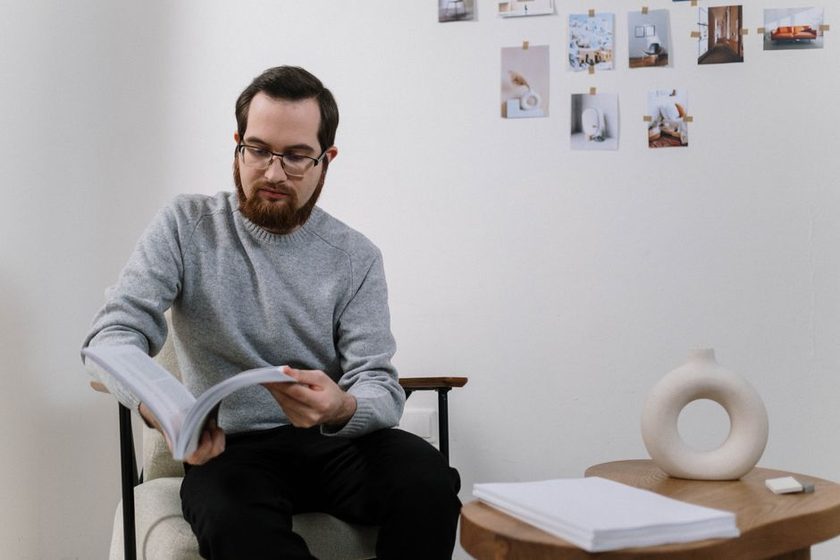
The book had been on the shelf for eleven months, spine uncracked past page forty, a receipt still folded into it as a bookmark. I picked it up on a Tuesday for no better reason than the phone was charging in another room and the evening felt long. What struck me first wasn't the story. It was how strange my hands felt holding still, how long it took my eyes to stop expecting the page to move.
The page that will not scroll
A screen almost always offers you the next thing before you've finished the current one — a suggested video queued below the one you're watching, a related post half-visible under the paragraph you're reading. A printed page offers nothing beyond its own edges. There is no infinite version of this page waiting underneath it. What you see is what there is, and when you reach the bottom you either turn the page or you stop. That's the whole menu.
This sounds like a small difference, and mechanically it is. But it changes what the eye does while reading. On a feed, part of attention is always reserved for what's coming — a low hum of anticipation that never fully resolves. On a fixed page, that reserved attention has nowhere to go, so it tends to fold back into the sentence you're actually in. I noticed, that first evening, that I was reading the same sentence more slowly than I read anything online, not because the sentence was hard but because nothing was competing for the rest of my attention.
What changes when nothing pings
A book does not notify you. It does not know you exist between the moments you're looking at it. That absence of feedback is part of what makes long stretches of reading possible — there's no small reward loop keeping you circling back, and so the mind, after a page or two of restlessness, tends to settle into the material itself. It's worth comparing this with the piece on attention residue, which gets at why switching away from a task and back again costs more than it seems to in the moment. A paper book, simply by not competing for switches, removes most of the opportunities for that cost to accrue.
None of this makes screens bad or paper virtuous. A screen is extraordinary for finding things, comparing things, moving quickly between related ideas. A book is better suited to staying with one thing longer than feels efficient. The point isn't that one format wins. It's that they ask different things of attention, and it can be useful to know which one you're reaching for and why.
The physical cues most people forget
Paper carries a kind of memory that a screen doesn't. You remember a passage was near the top of a left-hand page, roughly a third of the way through the book, underlined in blue. That spatial memory — thickness of pages read versus unread under your thumb, the visible progress of a bookmark moving through the block — gives reading a shape you can feel before you can articulate it. Digital reading, for all its convenience, tends to flatten that shape into an undifferentiated scroll or a percentage counter.
- The weight of the remaining pages tells you, without checking, how much is left.
- A dog-eared corner or a pencil mark is a cue your body finds again by habit, not by search.
- Turning a page is a small, repeated motion that keeps the hands lightly occupied — a kind of built-in pause the format includes for free.
A quieter kind of boredom
There's a particular restlessness that shows up in the first few minutes of reading paper after a long stretch of screens — a mind that keeps reaching for a scroll bar that isn't there. It passes, usually within a page or two, but it's worth naming rather than fighting. Some people find it helps to treat that restlessness the way you'd treat the slow start described in the case for a slow first hour — not a problem to push through quickly, but a threshold that takes its own time to cross.
The page doesn't ask for your full attention. It just declines to offer you anywhere else to put it.
A small comparison
It can help to see the differences laid out plainly rather than argued for. Neither column is the "right" one — they're just different tools for different moments in a day.
| Aspect | Paper book | Scrolling screen |
|---|---|---|
| Next content | Not visible until you turn the page | Often visible below the current line |
| Progress cue | Felt physically, in the thickness of pages | Shown as a number or a thin bar |
| Interruptions | None built into the object itself | Notifications, autoplay, related items |
| Best suited for | Staying with one long thread of thought | Comparing, searching, moving between ideas |
| Natural pause | The page turn | Rarely built in; has to be self-imposed |
Bringing a little of it back
You don't need to give up screens to notice something from this. The more useful move is smaller: picking one stretch of the day where the object in your hands simply doesn't do anything else. If a full book feels like too large a commitment to start, the Stillhour app's timed reading sessions are built around the same idea in miniature — a fixed, quiet block with nothing waiting underneath it.
What surprised me most, months into this small habit, wasn't that I read more — some weeks I read less than I used to. It was that the reading I did felt more like mine. Fewer sentences skimmed and forgotten, more that I could still describe a day later. That's not a small thing, even if it's a quiet one, and it pairs well with keeping a quiet house in the background rather than filling every room with sound while you read.